Prof. Kolemen awarded DOE Genesis Mission grant to build world models for fusion plasmas
Prof. Egemen Kolemen has been awarded a Genesis Mission grant from the U.S. Department of Energy to build multimodal world models for fusion plasmas. He is one of four Princeton faculty members selected under the initiative.
The grant is part of a nationwide DOE effort spanning 278 projects that aims to double America's scientific productivity by pairing artificial intelligence and high-performance computing with the agency's scientific capabilities.
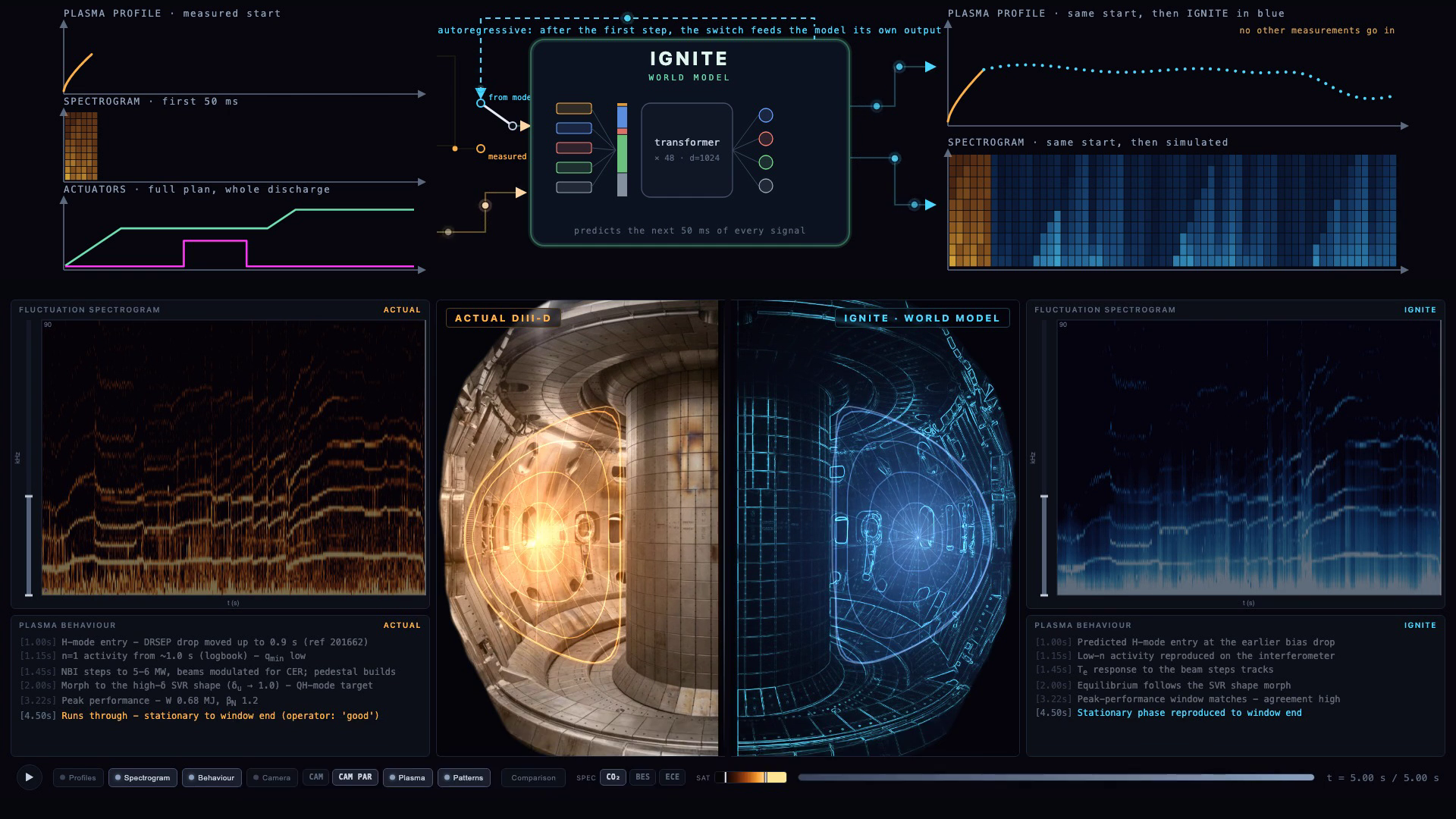
Our team is training an world model that predicts plasma behavior in fusion devices far into the future, and building a digital twin that simulates a whole experiment from its initial conditions and actuator plan. Scenarios can then be proposed, tested, and optimized in simulation rather than on the machine, shortening the path to commercial fusion power.
The result is IGNITE, the first multimodal world model for the DIII-D National Fusion Facility learned from years of experimental data. Given only the initial state of a discharge and the actuator trajectories, IGNITE runs autoregressively, feeding its own predictions back to itself, and simulates the profiles, spectrograms, and equilibrium for the rest of the shot. It also accepts a request in plain language, suggests a plan based on what it has learnt from historical discharges, and lets an operator edit the actuators directly to see how a never-before-run scenario would play out.
The one-minute video below walks through the model and the interface built around it.
IGNITE is led by Egemen Kolemen (Princeton University / PPPL), with Peter Steiner, Azarakhsh Jalalvand, Kouroche Bouchiat, and Nathaniel Chen at Princeton University, SangKyeun Kim and Ricardo Shousha at PPPL, and the DIII-D team at General Atomics.
Continue reading the Princeton University news article.